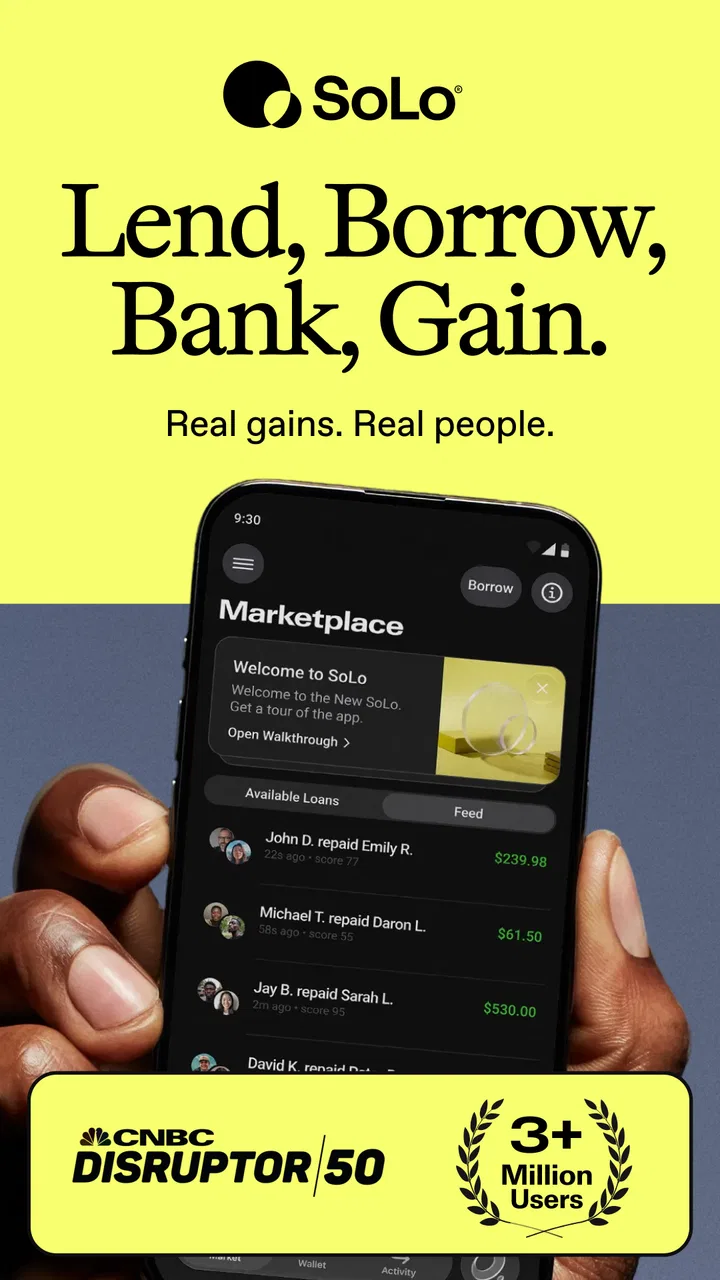
SoLo Funds: Lend & Borrow
- 4.6
- Rating
- 500.00K
- Installs
- Free
- Price

 Analysis by App-foxy
I approached SoLo Funds: Lend & Borrow as a practical finance app rather than a conventional banking replacement. Its central idea is simple: people can request short-term borrowing on their own terms, while other users can lend with the possibility of benefiting from that activity. That makes it most interesting when you need a flexible option for a temporary cash gap, or when you want to understand a community-based alternative to familiar financial services.
The app is free to download, aimed at Everyone, and developed by Solo Funds. It sits in the finance category, where expectations are naturally high: I want clear information, dependable access, and enough control to make a sensible decision before money is involved. My overall impression is that this is a focused tool for people who understand what they are signing up for, not a universal answer to every borrowing problem.
How SoLo Funds feels in everyday use
The first thing I noticed is that the concept requires more attention than simply opening a standard savings or budgeting app. Borrowing and lending are decisions with consequences, so speed should not be confused with convenience. A quick screen or a straightforward request can be useful, but I would still take time to review the terms shown in the app and make sure the arrangement fits my budget.
You May Also Like

 Google Keep - Notes and lists
Google Keep’s Quiet Growth Shows the Appeal of Simpler Notes
As mobile work gets busier, Google Keep keeps winning a simple contest: capture a thought quickly, find it later, and get on with the day.

 Blood Strike: 2.5 Anniversary
Blood Strike’s Loadouts Turn Every Drop Into a Tactical Gamble
A close look at Blood Strike’s custom loadouts: how fast access to signature weapons reshapes its battle royale rhythm, rewards preparation, and narrows the gap between fights.

 Pandora - Music & Podcasts
Pandora’s Music Is Easy to Start, but Harder to Recover
Pandora’s strength is its low-effort path from a seed to a station. Its weak spot is how much confidence it asks you to place in connection, setup, and quiet recovery.

 8 Ball Pool
 Is Built on Rivalries, Rematches, and Routine
A close look at the rivalries, rematches, shared routines, and unanswered safety questions that turn a quick pool match into a persistent mobile community.

 Samsung Music
’s Quiet Strength Is Playing What You Already Own
Its reach comes less from spectacle than from dependable access to a personal library. That simplicity is both the app’s strongest retention engine and its ceiling.

 AccuWeather: Weather Radar
AccuWeather Review: A Quick, Clear Forecast for Everyday Decisions
For everyday plans, the best forecast is the one you can understand quickly. AccuWeather makes rain timing, radar, and local conditions easy to act on, with a few trade-offs.
More From Our News Desk



That distinction matters in a realistic situation. Imagine an unexpected bill arriving just before payday. A person may be tempted to treat the app as an instant emergency button, but the better workflow is to check the amount needed, consider whether repayment is genuinely manageable, and then compare the available choice with asking a bank, employer, family member, or another established provider. The app may offer flexibility, but flexibility is only helpful when the repayment plan is realistic.
For lenders, the experience calls for a different mindset. This is not the same as leaving money in a conventional savings account and forgetting about it. A lender needs to think about liquidity, risk, and whether the money can remain committed without causing personal financial pressure. I would never use funds needed for rent, food, bills, or an upcoming emergency simply because the lending side appears attractive.
The developer presents the service around borrowing on personal terms and lending to gain benefits. In practice, that wording should encourage careful reading rather than impulsive use. The most useful feature is the ability to participate in a different kind of financial exchange; the trade-off is that the user has to take more responsibility for understanding the decision.
What affects the feeling of speed
Perceived speed in a finance app is not just about how quickly a page opens. It also depends on how quickly I can understand the available information, complete the necessary steps, and know what happens next. SoLo Funds can feel direct when I already know my goal, but the financial context means I should not rush through screens merely to finish faster.
Someone looking for a small, temporary solution may appreciate a focused flow instead of navigating a full banking suite. On the other hand, a user who expects the same instant certainty as a card payment or a routine transfer may find the process less predictable. Financial requests involve decisions and conditions, so an app cannot be judged only by the number of taps.
My practical tip is to prepare before opening it. Know the amount you need, the date by which you expect to repay it, and the maximum commitment you can safely handle. Having those answers ready makes the experience feel faster because the difficult part is financial judgement, not typing. It also reduces the chance of accepting an option simply because it is visible at a stressful moment.
For lenders, preparation is even more important. Decide in advance how much money you can set aside without affecting your own plans. That turns the app from an impulse-driven tool into a deliberate part of a broader money routine. I also recommend keeping a separate record of what you commit and when you expect the funds to become available again, rather than relying on memory.
When the app is under heavier pressure
Heavy use can mean several things here. It may involve checking opportunities repeatedly, reviewing a borrowing request while under time pressure, or using the service during a personal cash-flow problem. The app’s resource demands are difficult to judge from appearance alone, but its finance-focused purpose suggests that the bigger challenge is cognitive load rather than entertainment-style processing.
On an older phone, the experience may be affected by the operating system, available storage, background activity, or a crowded network connection. The minimum supported operating system is Android 8.0, so users on older software should check compatibility before planning around the service. Even when the app installs successfully, an aging device can make authentication, page transitions, or updates feel less comfortable than on a newer phone.
I would also avoid using it while multitasking heavily. Switching between a finance app, messages, email, and a browser can make it easier to lose track of which details were reviewed. A calmer workflow is safer: open the app, examine the request or lending opportunity, note the important terms, and finish the decision without treating it like background scrolling.
Another non-obvious trade-off is notification discipline. If alerts are enabled on a phone, they may draw attention at exactly the wrong time, especially when someone is already anxious about money. I would keep only the notifications that genuinely help me act, and I would avoid allowing a prompt to become the reason I lend or borrow. A notification can remind me to review something; it should not make the decision for me.
Heavy use also exposes a human limitation: the platform may be easy to revisit, but repeated checking does not necessarily improve the outcome. For borrowers, repeatedly looking for a solution can encourage taking more than needed. For lenders, repeatedly browsing may make available opportunities feel like spare cash opportunities. In both cases, setting a personal limit before using the app is more valuable than simply expecting the interface to provide discipline.
Reliability, confidence, and recovery
A finance app earns trust through more than a polished interface. I want to know that I can return to the same information, understand the state of a request, and recover calmly if my connection drops or I close the app. SoLo Funds has a substantial user base, with more than 500,000 installs and an average rating of 4.5 from roughly 23,000 ratings. Those figures suggest that many people have found the service useful, although they should not replace my own review of the terms and my personal tolerance for risk.
The app has also accumulated about 5,400 written reviews, which is useful context when deciding whether to try it. I would read recent comments with a specific purpose rather than looking only for praise: I would search for patterns involving clarity, timing, account access, and how users handled problems. A rating gives a broad signal, but written experiences are more helpful when I am considering a finance product.
My recovery advice is simple but important. If a page does not load, I would avoid submitting the same action repeatedly until I know whether the first attempt went through. I would check the app’s current state after reconnecting, keep any confirmation details available, and contact the appropriate support channel if something remains unclear. Repeating a financial action out of frustration can create confusion that a few extra seconds of checking would have prevented.
I would also keep the app updated when a new version is available, provided the phone remains compatible. The current version is 2.14.3, and staying current is generally sensible for an app handling personal financial activity. Still, updating immediately before an urgent transaction is not my preferred routine. I would rather update during a calm period, open the app afterward, and confirm that I can sign in and find the information I need.
Reliability also depends on the user’s records. I would save important confirmations in a secure place and avoid depending on a single screen as my only memory of a financial commitment. This is not a criticism unique to SoLo Funds; it is a sensible habit whenever an app is involved in borrowing or lending. If the phone is lost, replaced, or temporarily unavailable, a written personal record can make recovery less stressful.
Device limits and practical setup
The Android requirement of version 8.0 or newer makes the app accessible to a broad range of devices, but compatibility is not the same as an identical experience everywhere. A newer phone with current system software will usually be the more comfortable choice for any finance app, especially if the device has enough free storage and a stable connection.
I would avoid installing it on a phone that is shared casually with other people. A finance app deserves the same care as a banking application: use a personal device, protect the screen, and think about who can see notifications. The Everyone age rating describes the intended content audience, not a recommendation to ignore privacy around financial activity.
Users with limited data should plan their sessions rather than repeatedly opening the app throughout the day. The service is not the sort of application I would expect to consume entertainment-level resources, but connection quality still affects how comfortably I can review information. If the network is unstable, I would wait until I have a more dependable connection before making an important decision.
Battery life is unlikely to be the main reason to choose or reject this app, since the core activity is occasional financial review rather than continuous media playback. The more meaningful device constraint is attention. A small screen, poor visibility, or a cracked display can make it harder to inspect figures and terms carefully. If I cannot read the details comfortably, I would postpone the decision instead of relying on guesswork.
People using iOS should check the relevant App Store requirements separately before planning their workflow. The Android minimum version tells me how the Android edition is positioned, but it should not be treated as a universal requirement for every platform. Either way, I would make sure the device software is supported and that I can access the account reliably before depending on the app for an urgent need.
Who benefits most from this approach
I see the strongest fit among adults who want an alternative to conventional short-term borrowing and are willing to make careful choices. A borrower may value having more control over the request instead of accepting a rigid product designed around a bank’s standard process. A lender may appreciate participating in a peer-oriented model rather than leaving every financial decision to a traditional institution.
The app can also suit someone who wants to separate a specific short-term need from a larger banking relationship. For example, a person may keep everyday spending and savings with a bank while using SoLo Funds only when evaluating a particular borrowing or lending situation. That separation can make the purpose clear, provided the user does not mistake a secondary tool for a complete financial plan.
I would skip it if I need guaranteed certainty, cannot comfortably repay a short-term obligation, or would be putting essential money at risk as a lender. It is also not the right choice for someone who wants a conventional savings account, a full budgeting dashboard, or a normal bank account with familiar deposit and payment functions. A standard bank or credit union may be better for those needs.
Likewise, someone with an established low-cost credit option should compare the total commitment carefully rather than assuming a community-based model is automatically cheaper or easier. The right choice depends on the exact situation, the user’s ability to repay, and the consequences of a delay. Convenience should be one factor, not the deciding factor.
How it compares with familiar alternatives
Compared with a traditional bank, SoLo Funds feels narrower and more purpose-built. A bank generally offers a broader relationship: accounts, transfers, cards, statements, and established customer-service routines. That breadth can be reassuring for everyday money management. SoLo Funds is more appealing when the specific idea of peer borrowing or lending is the reason I am looking for an app at all.
Compared with a budgeting app, it is not primarily a place to categorize spending or build a long-term plan. A budgeting tool can help me discover why I keep running short and adjust my habits. SoLo Funds may address a particular short-term gap, but it does not remove the need to understand the underlying budget. In fact, using both approaches could be more sensible than expecting one app to solve the entire problem.
Compared with a credit card, the decision feels more deliberate but may offer less of the familiar convenience people associate with an established line of credit. A credit card can be useful for planned purchases when managed responsibly, yet it can also make overspending easy. The peer-oriented structure here may encourage a more specific request, but that does not automatically make it safer for every borrower.
Compared with asking friends or family, the app creates a more structured digital setting, which some people may find less uncomfortable. The trade-off is that a personal relationship is replaced by an organized platform experience, and the user still needs to understand the financial responsibility involved. I would choose based on clarity and suitability, not embarrassment or speed alone.
Small habits that make the experience safer
My first practical habit would be to write down the exact amount needed before opening the borrowing flow. I would not start with “How much can I get?” but with “What bill or expense am I covering, and what is the smallest amount that solves it?” That change reduces the chance of turning a temporary need into a larger obligation.
Second, I would review the repayment plan when I am calm, not when a deadline is already causing panic. If the future payment would leave me short for essentials, the app is not solving the problem; it is moving the pressure forward. In that situation, I would look for a lower-cost alternative, negotiate the bill, or seek financial guidance instead.
Third, lenders should treat every commitment as money that may not be available immediately. I would keep an emergency reserve outside the app and set a firm personal ceiling for lending. This is a more useful safeguard than trying to maximize every possible benefit, because access to cash matters more than an attractive opportunity when an unexpected expense appears.
Fourth, I would review the app from the same device and connection whenever possible. Consistency makes it easier to notice unusual behavior, missing information, or a sign-in problem. I would never share account credentials through messages, and I would be cautious about using public Wi-Fi for sensitive financial activity.
Finally, I would judge the service over several calm interactions rather than one urgent session. The first use tells me whether the concept fits my needs; later use tells me whether I can maintain good habits around it. That is especially important because finance apps are not just tools for completing tasks. They shape how quickly I act when money feels tight.
My performance verdict
SoLo Funds is a focused finance app with a distinctive purpose, and I think it is most valuable when used deliberately. Its free access, broad Android compatibility from version 8.0 onward, and growing audience make it easy to consider, while the 4.5 average rating indicates a generally positive reception. The current 2.14.3 release gives users a clear version reference when checking their device and keeping the app maintained.
My reservation is not about whether the concept is interesting; it is about the responsibility attached to it. Borrowers need a repayment plan that works in real life, and lenders need money they can afford to leave committed. The app should not be treated as a shortcut around budgeting, emergency savings, or careful comparison with banks, credit unions, credit cards, and personal support networks.
In terms of perceived performance, I would expect the best experience from a supported, reasonably current phone, a stable connection, and a user who is prepared before starting. I would not make a decision while distracted, repeatedly retry an uncertain action, or depend on the app as my only record. Those habits do more for reliability and recovery than chasing a faster workflow.
My recommendation is cautious but positive: try it if you specifically want a peer-based borrowing or lending option and are prepared to read carefully, plan ahead, and accept personal responsibility. Skip it if you need a complete banking service, guaranteed certainty, or a solution to debt that your budget cannot support. Used with those boundaries, SoLo Funds: Lend & Borrow offers a genuinely different way to approach a short-term financial need without pretending that convenience removes the need for judgement.
FAQs for SoLo Funds: Lend & Borrow
01What is SoLo Funds and how does it work?
SoLo Funds is a peer-to-peer lending platform designed to connect individuals who need short-term loans with those willing to lend money. Users can request loans ranging from $50 to $500, which are typically repaid within 30 days. The app facilitates the transaction, ensuring a smooth process for both borrowers and lenders.
02Is SoLo Funds safe to use for transactions?
Yes, SoLo Funds implements various security measures to protect user data and transactions. The app uses encryption to safeguard personal information and employs identity verification processes to ensure all users are legitimate. However, it's always wise to exercise caution and review their privacy policy for additional details.
03Are there fees associated with using SoLo Funds?
While SoLo Funds does not charge interest, there are optional fees involved. Borrowers can choose to offer a "tip" or donation to lenders as an incentive, and a small platform fee may be applied. It's important to review the terms and conditions to understand any potential costs before proceeding.
04How long does it take to receive a loan on SoLo Funds?
The time it takes to receive a loan can vary. Once a borrower submits a loan request, it depends on how quickly a lender accepts it. Funding can happen in just a few hours, but it may take up to a few days. Prompt communication and profile completeness can expedite the process.
05What happens if I can't repay my loan on time?
If you're unable to repay your loan by the due date, it's crucial to communicate with your lender through the app. SoLo Funds provides options such as extensions to help manage repayment. However, repeated late payments may affect your standing and ability to obtain future loans.
Pros
- Easy peer-to-peer lending platform.
- No hidden fees or extra charges.
- Flexible repayment terms.
- Quick approval process.
- User-friendly interface.
Cons
- Limited to US residents only.
- Interest rates can be high.
- Requires access to bank account.
- Potential for loan default.
- Limited loan amounts available.

SoLo Funds: Lend & Borrow
Gallery